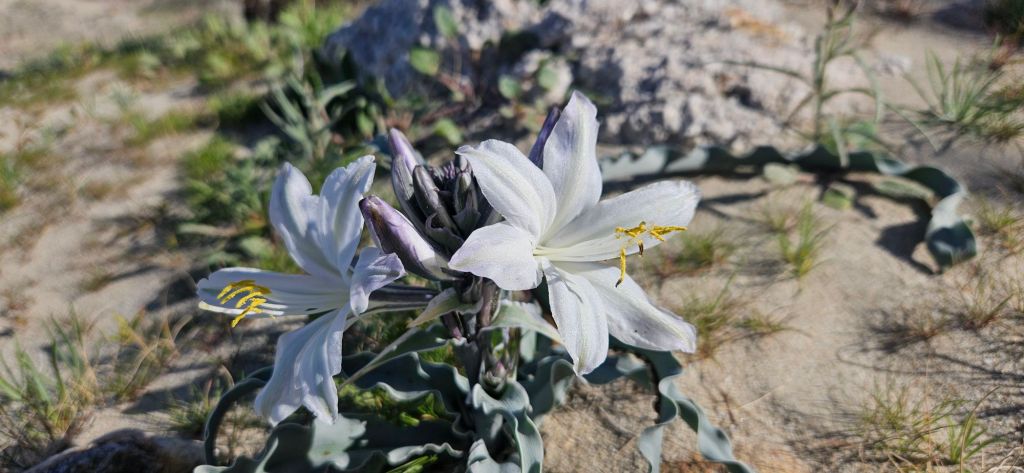

Desert lilies (Hesperocallis undulata) are blooming in Anza-Borrego Desert State Park after recent winter rains. These elegant flowers are joining the other early bloomers, like the sand verbena and primrose, in marking the surprisingly early wildflower season in the desert.
Where the Desert Lilies Are Blooming in Anza-Borrego
Unlike many other wildflowers that blanket hillsides, desert lilies tend to grow in isolated clusters, often tucked into washes or open sandy areas. You have to slow down to see them, and that’s part of their charm. Here’s where they’re appearing so far:
- Arroyo Salado Campground (that’s where I snapped these photos)
- Henderson Canyon Road
- Coyote Canyon
- And even as far east as the area around Truckhaven, where off-roaders play


Facts About Desert Lilies
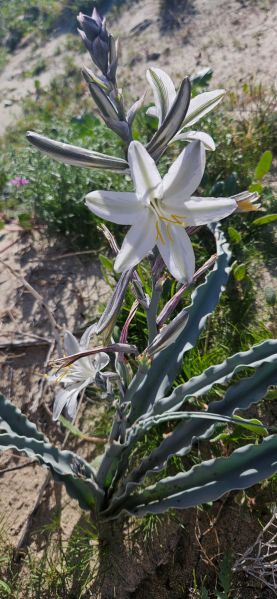
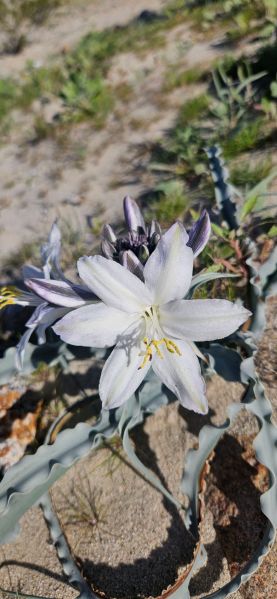
Of all the wildflowers that bloom in Anza-Borrego Desert State Park, these are my favorite. I love the white petals that rise up from the long slender stem and how they catch the light when the sun shines just right.
It’s always amazing to me how such a delicate looking flower can grow in such a harsh environment. They feel like a blessing in the desert. Here’s what I’ve learned about these beauties:
1. They’re Not True Lilies
The desert lilies we see throughout Anza-Borrego Desert State Park (Hesperocallis undulata) actually belong to the Amaryllidaceae family and are related to agaves and daffodils.
2. They Can Grow Fairly Tall
The desert lily’s flower stalks can grow up to three feet tall if given the right conditions. I’ve never seen one that tall, but now I know it’s possible.
3. They Have Bulbs That Store What They Need
Desert lilies are well adapted to arid life. Their bulb (which runs deep underground) stores water and nutrients that help them survive long, dry periods in the desert.
4. When They Bloom
Desert lilies typically bloom from late winter into early spring, with timing closely tied to winter rain patterns. After a dry year, they may not appear at all. After a wetter season, they can surprise you earlier than expected.
5. They Attract Night-Flying Pollinators
Their fragrant flowers attract night-flying pollinators like sphinx moths, which are active at dusk or dawn. A fun fact about sphinx moths: they’re often mistaken for hummingbirds, or even bats, because of their speed and agility.
Photographs on this page are a labor of love by Under the Borrego Sky. To respect the work behind the lens, please do not use these images without a quick hello and permission first.
 Under the Borrego Sky
Leave a comment